|

Blackjack Game Odds
Understanding the odds is a major factor in becoming
a successful player at blackjack. Blackjack is one of
the only casino games that is beatable, meaning that by acquiring
the right skills, players can swing the advantage into their
favor.
Article Highlights:
Gaining The Advantage | Strategy | Event Frequency | House Rules | Summary
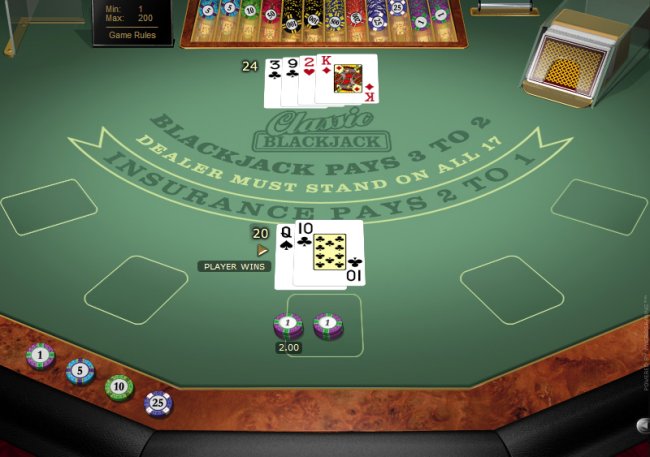 |
casino: Casino Action
For beginners, professionals and players in between, blackjack is a universally popular casino game due to its fast pace, relative simplicity, and excellent odds. |
Gaining The Advantage
An important step in mastering blackjack is learning how to play using
basic strategy. Players who rely solely on hunches and gut feelings to play will likely give up a much greater edge to the house. Basic strategy is relatively easy to learn and anyone can do this with a little practice online.
Learning to play blackjack using perfect basic strategy will reduce a casino's edge to a mere 0.80%
- the second lowest among all table games - and slightly to far better
odds than those offered at roulette tables and slot machines, respectively.
Blackjack is a dependent variable game, meaning that as each
card is dealt from the deck(s), the odds of any remaining
card - like an Ace or 10 - coming up next is constantly changing.
If you're playing a single deck game, before any cards have
been dealt, you know that the odds of any Ace being dealt
are 4 out of 52. If the first two cards dealt are both Aces,
then there is only a 2 out of 50 (or 1 in 25) chance that
the next card will be another Ace. Over time, experts have
used computer simulations to determine that high cards like
Aces and Tens are beneficial to the player, and conversely,
small cards are good for the dealer. If you are able to keep
track of which cards have left the deck, you would obviously
stand a better chance at knowing which cards remain, hence
which ones are most likely to be dealt on the next draw. This
is where the house edge is nullified, and the player begins
to build a small, yet sizable edge over the house. Such is
the advantage of becoming a skilled blackjack player.
While there are some differences between online
blackjack and blackjack at land-based casinos - perhaps
most notably the use of continuous shuffle at some online
casinos - this article focuses mainly on the basics, which
can be applied to most versions of the game.
Adjustments In Strategy
Once you have learned basic strategy, and then how to track the
count while playing, the next step is to vary your playing strategy
to account for the current game odds at any given moment. If you
know that the deck is loaded with face cards, you might not want
to hit on 12 against the dealer's up card of 10, knowing that
there is an increased likelihood that you will bust. If the deck
has lots of tens, you may decide to risk doubling on 11 against
a dealer's Ace, even though basic strategy says not to. It is small
modifications in play that will cut into the house's edge and put
those percentage points on your side.
Other variations in play include changing your betting level. If
the odds favor the player, bet bigger. If they favor the dealer,
bet smaller. This is common knowledge, but mastering the art of
knowing when and how to bet is a key factor in becoming a skilled
player. Something to keep in mind is that while adjusting your bets
according to the odds at any given time, do so in a reasonable manner.
This means avoiding the rapid escalation of bets when the odds shift
into your favor. Regardless of whether you're playing real
money blackjack at the Borgata in Atlantic City, or a game
of multi-player at your favorite online casino, if you jump from
10 to 100 units a hand, chances are someone will notice. Pit personnel
are trained to keep an eye out for exactly this sort of thing, so
you will need to moderate or disguise your betting. If the odds are in your
favor and you win a hand, double your next bet, or raise it by one
unit. This is a very natural betting pattern that any player might
use, and much less likely to draw unwanted attention. Also
note that many online casinos' software employ mathematical algorithms
that are programmed to detect wild swings in betting. So, since there
is no pit boss to give you the boot at your own computer, the odds
of many blackjack games at online casinos do not favor the player
when making a large escalation in bet from one hand to the next.
Stick with a similar raising strategy to what you'd use at a land
casino, and you will be better off.
Event Frequency
Another important factor in blackjack mastery is knowing how often
certain events occur. Maybe you've wondered how often blackjacks
come up, or what the win/loss/tie breakdown is between players and
the house. On average, a player will win 44% of the time, the dealer
48% and 8% of hands will result in a tie. With these odds, you might
logically deduce that a player will lose more money than he or she
will win. However, you must also take into account the built-in
player advantages that blackjack offers like doubling down, splitting,
and the fact that blackjack pays out at 3 to 2. While you will likely
end up losing more hands than you win, you should just about break
even monetarily, because you win more when you do win. If you win
a double down, you get twice what you would expect than for winning
only one hand, but it still counts as a single win for the player.
Also, if the dealer gets a blackjack, you lose only your initial
bet, instead of 1½ times the bet, which is what a player wins
by getting a blackjack.
The event frequency chart to the right shows us that both the player and the dealer can
expect a blackjack at a rate of 1 out of every 20 hands, or 5% of
the time. An important thing to remember is that when a dealer shows
an Ace, odds are that he or she will make a blackjack 32% of the
time, meaning there won't be one the other 68% of the time. If the
dealer has an Ace showing, you will be asked if you would like to
take the insurance bet, which pays 2 to 1. Since the dealer will
not have a blackjack 68% of the time, that's about how often you
can expect to lose this bet, thus reinforcing why basic strategy
says never to take the insurance bet. So when should you take the
insurance bet? Only when you're an expert card counter, and the
plus count is sky high, letting you know that the odds are actually
in favor of the dealer having a ten card under that Ace. Even then,
it is still a risky proposition, so, as a wise guy might say: "fuhgeddaboudit"!
House Rules' Effect For Players
If you've played blackjack in more than one location, odds are the
rules of the game had slight variations. Las Vegas Strip rules are
different from Downtown Las Vegas rules which are different from Atlantic
City rules which are different from online
blackjack rules and so on. So why is there no international
standard for blackjack table rules? Basically, casinos like to be
able to make small changes in their games to either attract or deter
certain types of players. While probably more than half of the tourists
and other recreational players only bother to look or inquire about
a game's rules as far as the table minimum, smart players know that
particular rules have direct relationships on the player's edge.
Certain rules impact the edge favorably for players, others add
to the house advantage. Looking for a game that has good rules is
another important factor in improving your odds.
The house rules chart (to the right) shows us what percentage (positive or negative) different
rule variations commonly found at today's casinos will have on a
player. Starting at the top, definitely avoid all games where the
dealer wins ties. This gives the house a big edge. Next, the lower
the number of decks being used, the better the odds for players.
Regardless of whether you're playing basic strategy, counting cards,
or just guessing, single and double deck games give you better odds
of winning. When you play multiple deck blackjack games dealt from a shoe,
a blank card (usually colored red or yellow) will be inserted towards
the end of the stack. All cards up to this card will be dealt during
the game. Once the card is reached, it is time to shuffle. Depending
on where the card is placed, the odds will improve or decrease for
players. This is known as "penetration". Closer to the
end of the stack (deeper penetration) is good for players because
more cards will come out of the shoe during a game, meaning you
have greater chances of predicting the remaining cards as the game
progresses. Shallow penetration is bad for the player for the opposite
reason. If the marker card is left only halfway into the stack, the
odds of predicting what will be drawn next is greatly reduced. Taking
it a step further, by playing single and double deck games, you
can eliminate this scenario almost entirely as all the cards are
usually dealt out.
Going back to the chart, you can see that being able to double on
only 10 and 11 has a negative effect for the player, while being
able to double on three or more cards and doubling after splits has
a positive effect. Look for games where the dealer stand on all
17s - which are pretty common at most land casinos. Avoid games
where the dealer does not take a second card until after the players
are done. While surrender has a positive effect for players, it
is rarely found these days, and even more rarely utilized properly.
For more information on surrender, see our blackjack
frequently asked questions section. Lastly, try to find games where you are allowed to re-split
aces. Most games give you but a single card on each Ace when you
split them, and do not allow resplitting of Aces. If you get an
Ace on top of your split Ace, naturally you would want to split
again, rather than stand on a 12, so this rule can have a big impact
on player odds.
Summary
Blackjack is a fun and exciting casino game that is popular with players
largely because it is beatable. Become a skilled player and the
odds will shift into your favor, giving you a positive expectation
of winning. This means that over time, playing blackjack will result
in more winning sessions and less losing ones. Understanding basic strategy
and counting techniques are critical to your success, but also having
good betting strategy and knowing how rules impact the odds is equally
important. Little things like these help players. Be sure to at
least learn basic strategy, and then you will likely be better skilled
than 80% of all blackjack players worldwide. All it takes is a little
practice.
Game Odds Articles:
Main Page | Baccarat | Blackjack | Craps | Keno | Roulette | Slot
Machines | Video
Poker
Play blackjack at one of the internet's leading casino sites.
Advertisement |


 Blackjack
Rules
Blackjack
Rules Blackjack Frequently Asked Questions
 Blackjack Strategy Charts
 Play Free Blackjack
 Mobile Blackjack
  Table Games Payouts
 Online Casinos
 Mobile Casinos
 Online Gambling
  Las Vegas